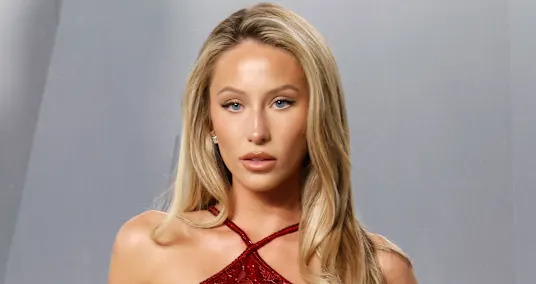
Alix Earle has always been up front about her acne.
Long before the launch of her skin care line, Reale Actives, on Tuesday, the 25-year-old TikTok influencer had documented her experience with cystic breakouts, including her use of Accutane and spironolactone to treat them. That transparency helped build the kind of trust that most beauty founders spend years trying to earn and positioned Earle as a credible voice for an audience dealing with their own acne issues.
But as Earle enters the skin care market, that backstory is being reexamined. Across social media, commenters are questioning exactly what her products promise and whether a years-long, prescription-driven skin journey can be cleanly translated into something you can just buy off the shelf.
The backlash isn’t really about whether Earle disclosed her treatments — she’s vlogged them and has even provided receipts in the days since the launch. It’s about how easily a complicated process gets retold as a simpler one and what happens when that version of the story becomes the foundation of a brand.
Breaking down the backlash
When Reale Actives launched this week, the reaction online was immediate and pointed. Though her followers were heavily involved in the creative marketing leading up to the reveal of Earle’s new brand, many quickly pivoted to questioning her as an authority about skin care.
The core question, echoed across social media, was this: How does a line designed for acne-prone skin fit into a journey Earle has previously attributed, at least in part, to prescription treatments?
The backlash reflects skepticism about what she’s selling. But it also reflects something more specific: confusion over what exactly cleared her skin — and whether that distinction is being blurred now that there’s a product involved.
“The backlash here isn’t surprising, but it is more nuanced than people are making it,” Olivia Bennett, senior digital PR director at Go Up, tells Yahoo. She says that Earle’s candidness about her acne is, in many ways, what made her compelling in the first place. “She’s been open about dealing with inflamed, acne-prone skin, and that kind of lived experience is something audiences really connect with.”
But that’s also what raises the stakes.
“The complication is the role medication has played in clearing her skin,” says Bennett. “People understand she’s been through it, but they’re also questioning how much of the visible results can realistically be attributed to skin care alone.”
In other words, the tension is about attribution — what came from prescription treatments as well as what a (nonprescription) product can realistically replicate. And that tension is amplified by the expectations audiences bring to Earle specifically.
How Alix Earle changed the acne conversation
Part of the reason the reaction feels so pointed is the role Earle has played in how acne is discussed online.
For years skin care content has tended to flatten the experience, reducing breakouts to the occasional blemish or positioning clear skin as something easily achieved with the right products. Earle’s approach stood out because it resisted that.
She documented her skin journey as something ongoing and, at times, unresolved. She shared flare-ups, tried different treatments and acknowledged when things weren’t working. The appeal wasn’t just that her skin improved over the years. It was that viewers saw how inconsistent and complicated that process could be.
“People saw someone with skin they recognized and related to,” says Bennett.
But with the launch of Reale Actives — which Earle describes as a lineup of “clinically proven products that have transformed my complexion, and my confidence” — that framing begins to shift.
“The backlash is coming from people who now feel that expectation might not fully match reality,” says Bennett.
A handful of comments on Earle’s Instagram posts about the brand reflect that. “Is this what you have been using for your acne? I know you’ve gone on countless Accutane journeys,” one person wrote. Another follower put it more bluntly: “You literally shared you went through rounds of Accutane. False advertising.”
Not everyone sees a problem.
“From my perspective, she’s the perfect person to be launching a skin care line,” Megan Vasquez, director of influencer strategy at Grin, tells Yahoo. “She's been so brutally transparent and honest about her skin, even when it was at its worst. … Why would we fault her for being honest?”
Vasquez argues that the same journey that critics are questioning is what gives Earle credibility in the category. She sees it as something that’s being interpreted without nuance.
“Acne is multifactorial, and skin care can be used alongside medication — and that's OK,” she says.
How Earle communicates that balance to her audience may ultimately determine the brand’s long-term success.
What comes next
If the backlash reflects a credibility question, it hasn’t slowed momentum.
Earle’s launch has already generated significant attention, with products quickly selling and online conversation dominating both fan communities and skeptic circles alike. The rollout — from teaser content to audience-driven marketing — has positioned Reale Actives as one of the most visible influencer beauty launches in recent memory. From a marketing perspective, that level of engagement matters.
“The volume of conversation is actually a positive,” says Bennett. “People are talking about it, debating it and paying attention, which gives the brand immediate visibility.”
But skin care operates differently from other influencer-led categories. Attention may drive launch-day success, but it doesn’t guarantee long-term trust.
That’s where Earle’s response becomes part of the story. In the days following the backlash, she has continued to address questions directly — reiterating her use of prescription treatments, offering more context around her skin journey and highlighting the use of real, unfiltered skin in her campaign images. That kind of transparency, experts say, may ultimately be the brand’s strongest asset.
The reaction to Reale Actives isn’t just about one influencer or one product line. It reflects a shift in how audiences engage with beauty more broadly. “They’re not just buying into a personality anymore, they’re analyzing ingredients, claims and context,” says Bennett. “That’s a very different landscape to even a few years ago.”
For founders like Earle, that means the challenge isn’t just launching a product. It’s telling a story that can withstand that level of scrutiny.
LATEST POSTS
- 1
 Figure out How to Explore Land Close to 5G Pinnacles
 - 22026 will be the year NASA astronauts fly around the moon again — if all goes to plan
- 3The most effective method to Plan an Incineration Administration: A Bit by bit Guide.
- 4Top 15 Web-based Entertainment Stages for Individual Marking
- 5Excelling at Discussion: Genuine Examples of overcoming adversity





- No more attempts to free whale stranded off Germany, officials say
- Traveling Alone: An Excursion of Self-Disclosure
- All that You Really want to Be familiar with Dental Inserts Facilities
- Instructions to Utilize Your Brain science Certification to Work on Corporate Culture
- Dancing through the crackdown: The satirical song soundtracking post-Khamenei Iran
- Israeli girl suffers cardiac arrest during sirens in Safed, hospitalized in serious condition
- 6 Famous Cell phone Brands All over The Planet
- Smoking rate among US adults drops to record low as vape use rises, CDC report finds
- Vote in favor of the Top Vegetable for Senior